Streaming more sustainable than traveling
When you, as a cultural organization, offer livestreams or video on demand (VOD), it means your online audience does not need to travel to your theater. This saves travel miles and associated CO₂ emissions. The CO₂ emissions per visitor of a cultural (live) stream are significantly lower than those of an audience attending a physical performance.
This was already evident from research by PHI Factory in collaboration with DEN in 2024. Our most recent in-depth research confirms this and further analyzes the figures. This provides a more precise insight into where the environmental impact of online cultural offerings lies and where opportunities exist for further digital sustainability.
The streaming process in six steps
The in-depth research by PHI Factory and DEN examines the climate impact of streaming and video on demand for cultural organizations. These insights come from recent sources on streaming and its CO₂ emissions.
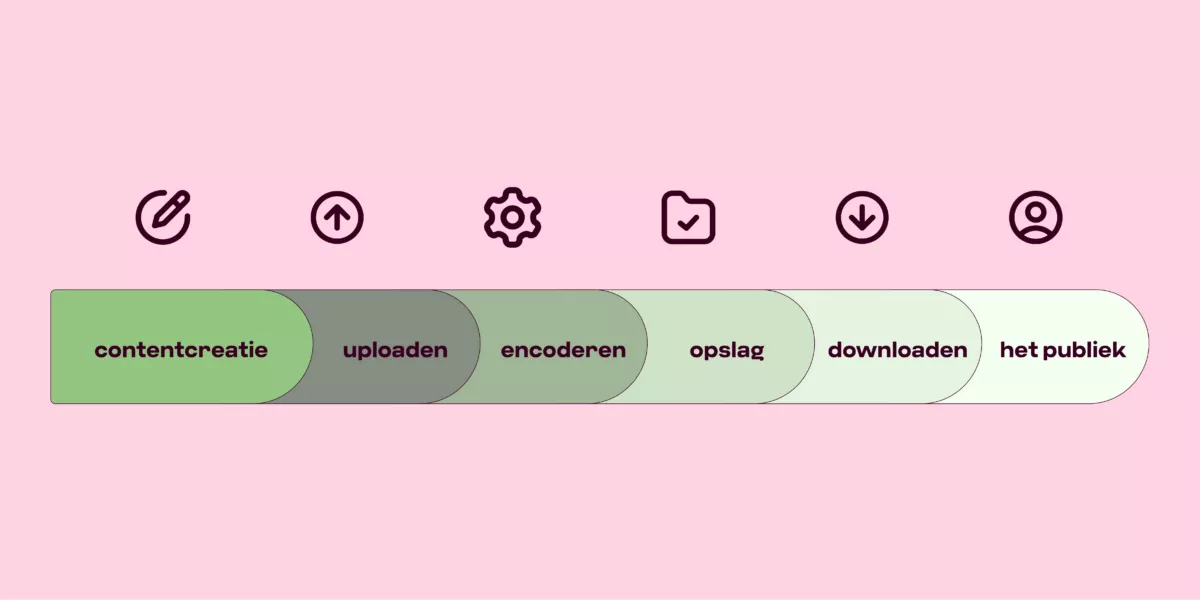
When creating and publishing digital cultural offerings online, six steps are followed: content creation, uploading, encoding, storage, downloading, and finally, playback by the audience. For each step, you can read where the environmental impact arises and what opportunities exist for sustainability.
Streaming: where is the environmental impact and how can you make it more sustainable?
Content creation
Hide explanationShow explanation
Content creation
Where emissions arise: Recording video and audio on location and editing. The energy consumption of cameras, microphones, laptops, and rendering processes.
Practical tips: Use energy-efficient hardware. Work on a laptop with an efficient processor and avoid unnecessary visual effects. Opt for a lower resolution where possible, for example, 1080p instead of 4K.
Uploading
Hide explanationShow explanation
Uploading
Where emissions arise: Data traffic of the original (large) files to the platform. Energy consumption and any real-time encoding during livestreams.
Practical tips: Compress the video before uploading. Preferably use a wired connection or Wi-Fi. Upload during off-peak hours if possible.
Encoding
Hide explanationShow explanation
Encoding
Where emissions arise: Converting to different file formats and resolutions. This takes place on powerful servers in data centers.
Practical tips: Choose an appropriate resolution. Is your video intended for mobile or social media? Then 720p is sufficient. Preferably choose a European provider that uses renewable energy.
Storage
Hide explanationShow explanation
Storage
Where emissions arise: Storage of multiple versions in different resolutions and backups.
Practical tips: Delete outdated or rarely viewed files. Limit duplicate backups.
Downloading
Hide explanationShow explanation
Downloading
Where emissions arise: Data transfer to the viewer. The amount of data transferred and high resolutions determine electricity consumption.
Practical tips: Encourage offline downloads for later use and advise viewers to delete files after watching. Recommend using Wi-Fi instead of mobile data.
The audience
Hide explanationShow explanation
The audience
Where emissions arise: Playback on their own device. Energy consumption of smartphones, tablets, laptops, or television screens.
Practical tips: Encourage viewers to watch on a smaller screen and via Wi-Fi. Remind them to disable autoplay on video platforms.
Video on demand more efficient than livestreaming
Livestreaming is estimated to consume three to five times more energy per viewer than video on demand (VOD). VOD, on the other hand, requires more permanent storage capacity, but this consumes less energy than livestreaming.
This difference arises because video fragments in livestreaming are encoded in real-time at the data center in various resolutions. This requires high computing power since each new minute is processed immediately. As a result, the energy consumption per viewer for livestreaming is higher than for VOD of a recording. For VOD, the rendering and network process only takes place once.
Top 4 findings from the research on CO₂ emissions of streaming/video on demand in 2025
- Wi-Fi is more sustainable than mobile internet: A fixed network (such as Wi-Fi) consumes less energy than a mobile network. Fixed internet consumes approximately 0.05 kWh per gigabyte; mobile internet about 0.12 kWh per gigabyte.
- VOD is more efficient than livestreaming: A livestream consumes three to five times more energy per viewer than video on demand. This is because, in livestreaming, every minute of content must be encoded in real-time.
- Online offerings emit less than mobility: During the production of 'The Shell Trial' by Nationale Opera & Ballet, it was found that only 0.87% of the total CO₂‑emissions came from the VOD version. Travel by the audience and cast, on the other hand, caused the largest emissions.
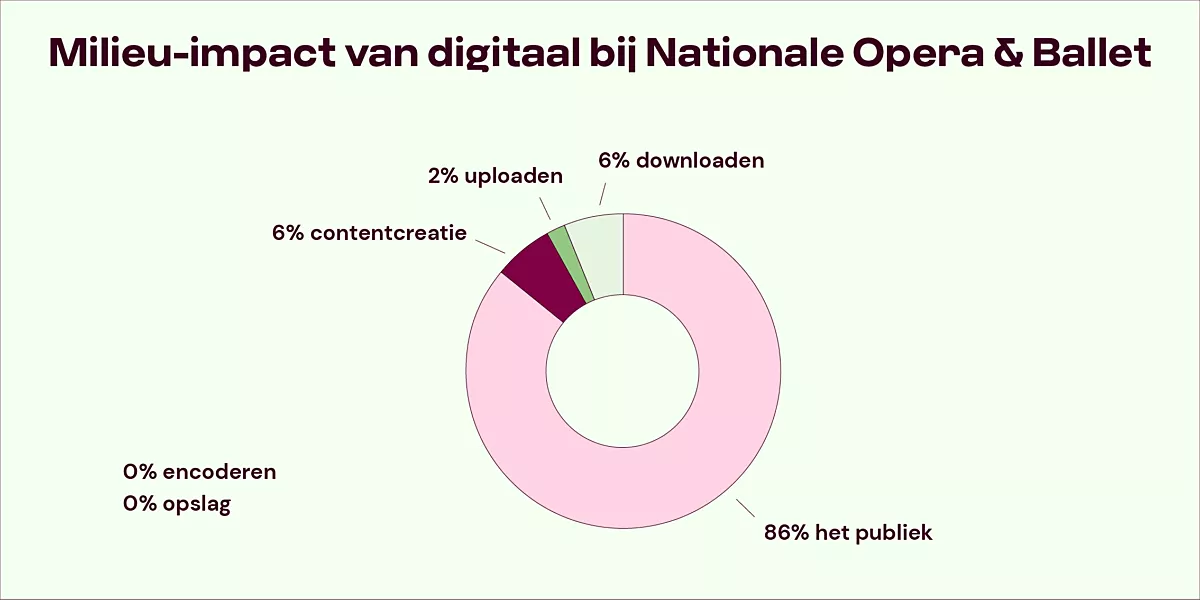
- Online audience accounts for the largest share of digital emissions: Of all the steps in digital cultural offerings, the majority of CO₂‑emissions come from the online audience: playing content on their own device. This falls under scope 3, meaning emissions that occur outside the organization itself. Our research at Nationale Opera & Ballet shows the following distribution: online audience 86%, content creation 6%, downloading 6%, uploading 2%. Encoding and storage have a very limited share in comparison.
Conclusion: Online performances are a sustainable addition to physical stage performances, provided they are produced and distributed efficiently.

More articles per topic